Showing posts with label Thomas Morris. Show all posts

Wednesday, October 28, 2015

Russian warplanes hit record 118 Syria targets in 24 hours: Moscow

Moscow (AFP) - Russian warplanes have struck 118 "terrorist" targets in Syria over the past 24 hours, its highest daily total yet, the defence ministry said Wednesday, attributing the rise to fresh intelligence.


Russian jets hit 118 targets during 71 sorties over the provinces of Idlib, Homs, Hama, Aleppo, Damascus and Latakia, said the defence ministry.
It was the highest one-day tally since the Kremlin began its bombing campaign on September 30.
The previous record was set on Monday when Moscow said it had struck 94 "terrorist" targets in Syria.
The defence ministry released no information on Tuesday.
"The number of sorties has gone up," the ministry said in a statement.
"This is due to an increase in intelligence data," he said, adding that targets had been "confirmed via various channels."
The strikes destroyed a command post near the town of Talbisseh in Homs province that belonged to Al-Qaeda affiliate Al-Nusra Front, said the ministry.
Among the other targets was a base in Aleppo province used to control a "terrorist" weapon supply route which was "destroyed", along with the vehicle-mounted anti-aircraft systems that were protecting it, it said.
In Sahl al-Ghab valley, which lies between the provinces of Hama and Idlib, the warplanes hit a "camouflaged supply base", causing an explosion that also destroyed trucks parked some 500 metres away.
Russian forces also hit a command and communications post of Jaish al-Islam (Army of Islam) group near Mesraba, a town north-east of Damascus, and "completely destroyed" a command post in Salma, Latakia, after discovering it with unmanned aerial vehicles.
Moscow says its bombing campaign targets Islamic State jihadists and other "terrorists" but the United States and its allies accuse Russia of targeting Western-backed moderate rebels fighting Kremlin-backed President Bashar al-Assad's forces.

Friday, September 11, 2015

Evidence Suggests Key Russian Brigade In Crimea Seizure Deploying To Syria


With the fog of war swirling around Russia’s military intentions in Syria, a growing body of evidence pointing to the actual units being deployed suggests Moscow may have much bigger plans in the works, security experts say.
Photographs and videos compiled by bloggers in recent days have yielded images of Russian tanks, aircraft, artillery, and other equipment in Syria, as well as naval ships traversing Turkey’s Bosphorus. 
Meanwhile, Russian blogger Ruslan Leviyev has discovered evidence on Russian social=media sites pointing to Moscow’s deployment to Syria of troops from a brigade prominently involved in the stealth campaign to seize Ukraine’s Crimea Peninsula last year.
This unit -- Russia’s 810th independent Naval Infantry Brigade -- was one of at least three involved in the takeover of Crimea, in which armed, camouflaged men lacking identifying insignias seized strategic points around the peninsula in February and March 2014. 
Leviyev found a post on the popular Russian social-networking site Vkontakte by a man identified as Anatoly Golota, who said he belonged to a subunit of the 810th Naval Infantry Brigade. The VKontakte profile has since been deleted, but in an archived September 1 post, the user wrote: “Off to Syria.”
Another Vkontakte profile featured a “contract” soldier named Maxim Mazhnikov, who also appears to be serving with the 810th brigade. One photograph appears to show Mazhnikov standing in shorts, a T-shirt, and flip-flops next to an illustrated poster showing Syrian President Bashar al-Assad and Russian President Vladimir Putin with the caption “The Time Of Courage And Real Men.” 
‘Power-Projection Operation’
Military observers say the 810th brigade consists of around 2,500 troops and is considered a capable unit that in the past has participated in operations in Georgia, antipiracy efforts off Somalia, and in Chechnya, where it suffered casualties during Russia’s second war with separatists that began in 1999.

“These are the guys who would go in first. Probably the case is that a bigger contingent will be coming sooner,” said Stephen Blank, a Russian foreign policy and defense expert at the Washington-based American Foreign Policy Council. “These are the guys who would go first in a power-projection operation.”
 
Mark Galeotti: "It’s clear the Russian are upping the ante in Syria."
Mark Galeotti, a professor at New York University who researches Russia’s security and military structures, said the 810th brigade not only performed effectively in Crimea, but its subunits may have also rotated through front lines in eastern Ukraine, where Kyiv’s forces have battled pro-Russian separatists in a bloody war that erupted in April 2014.
This would mean that more of the brigade’s officers have actual combat experience, he said.

“It’s clear the Russian are upping the ante in Syria, including combat troops rather than just specialists and trainers and tactical advisers,” Galeotti told RFE/RL. “Yes, it’s noteworthy, but it’s not something that will tilt the battlefield for Syria, for Assad’s forces.”
Russian Foreign Ministry spokeswoman Maria Zakharova this week confirmed the presence of Russian military personnel in Syria, Russia’s longtime ally. But she said they are merely specialists assisting with arms deliveries, something Moscow has provided Syria with for years.
WATCH: What Are Russian Troops Doing In Syria?
Zakharova also said that the Russian deployment was aimed at combating terrorism and the Islamic State militant group in particular -- an argument that fits into the Kremlin's insistence that backing Assad is essential to defeating the militants.
Both NATO and the United States have expressed concerns over reports of a growing Russian military presence in Syria.
Supply-Line Hurdles
It remains unclear exactly what Russia’s longer plan for its presence in Syria might be. 
Galeotti said a sustained operation could prove difficult because Russia has few good supply lines. Moscow lacks the equipment to airlift large numbers of troops or heavy weaponry like tanks, so the materiel would have to be sent by ship, which is more time-consuming and more visible to surveillance in passing through Istanbul, he said.

Galeotti added that Russia’s best-trained combat units and related forces have been stretched thin by the fighting in eastern Ukraine over the past year, though Russia denies accusations by Kyiv and the West that it is supporting the rebels with troops, training, and weapons.
If a larger contingent were to be deployed to Syria, it would potentially hamper Russian actions in Ukraine unless the Syria deployment involved conscripts, which is highly unlikely, Galeotti said.
Earlier this week, Dmitry Gudkov, one of the only independent legislators in Russia’s lower house of parliament, sent a letter to the Russian Defense Ministry asking specifically if Russian soldiers were being sent to Syria. 
“I doubt that the Sunnis, or Shi’a, or the Alawites of the Middle East ought to be more valuable to Russia than its own citizens,” Gudkov wrote in an accompanying Facebook post.
“Enough with us fulfilling our ‘international obligations,’” Gudkov added, before making reference to the disastrous Soviet war in the 1980s. “We paid in full in Afghanistan.”

Russia tells Washington: talk to us over Syria or risk 'unintended incidents'

Russia tells Washington: talk to us over Syria or risk 'unintended incidents'


Russia called on Friday for Washington to restart direct military-to-military cooperation to avert "unintended incidents" near Syria, at a time when U.S. officials say Moscow is building up forces to protect President Bashar al-Assad's government.
The United States is leading a campaign of air strikes against Islamic State fighters in Syrian air space, and a greater Russian presence would raise the prospect of the Cold War superpower foes encountering each other on the battlefield.
Both Moscow and Washington say their enemy is Islamic State. But Russia supports the government of Assad, while the United States says his presence makes the situation worse.
In recent days, U.S. officials have described what they say is a buildup of Russian equipment and manpower.
Lebanese sources have told Reuters that at least some Russian troops were now engaged in combat operations in support of Assad's government. Moscow has declined to comment on those reports.
At a news conference, Foreign Minister Sergei Lavrov said Russia was sending equipment to help Assad fight Islamic State. Russian servicemen were in Syria, he said, primarily to help service that equipment and teach Syrian soldiers how to use it.
Russia was also conducting naval exercises in the eastern Mediterranean, he said, describing the drills as long-planned and staged in accordance with international law.
Lavrov blamed Washington for cutting off direct military-to-military communications between Russia and NATO over the Ukraine crisis, saying such contacts were "important for the avoidance of undesired, unintended incidents".
"We are always in favor of military people talking to each other in a professional way. They understand each other very well," Lavrov said. "If, as (U.S. Secretary of State) John Kerry has said many times, the United States wants those channels frozen, then be our guest."
U.S. officials say they do not know what Moscow's intentions are in Syria. The reports of a Russian buildup come at a time when momentum has shifted against Assad's government in Syria's 4-year-old civil war, with Damascus suffering battlefield setbacks this year at the hands of an array of insurgent groups.
Moscow, Assad's ally since the Cold War, maintains its only Mediterranean naval base at Tartous on the Syrian coast, a strategic objective.
In recent months NATO-member Turkey has also raised the prospect of outside powers playing a greater role in Syria by proposing a "safe zone" near its border, kept free of both Islamic State and government troops.
COMMON ENEMY
The four-year-old multi-sided civil war in Syria has killed around 250,000 people and driven half of Syria's 23 million people from their homes. Some have traveled to European Union countries, creating a refugee crisis there.
Differences over Assad's future have made it impossible for Moscow and the West to take joint action against Islamic State, even though they say the group, which rules a self-proclaimed caliphate on swathes of Syria and Iraq, is their common enemy.
French Foreign Minister Laurent Fabius said on Friday it was too early to judge what exactly Russia's motivations at present were in Syria, but ‎that "adding war to war" would not help resolve the Syrian conflict.
"If it's about defending the base in Tartous why not? But ‎if it's to enter the conflict ...." he said, without finishing the thought.
BARGAINING POWER
Diplomats in Moscow say the Kremlin is happy for the West to believe it is building up its military in Syria, calculating that this will give it more bargaining power in any international talks about whether Assad stays in power.
Western and Arab countries have backed demands from the Syrian opposition that Assad must give way under any negotiated settlement to the war. Assad refuses to go and so far his enemies have lacked the capability to force him out, leaving the war grinding on for years. All diplomatic efforts at a solution have collapsed.
Assad’s supporters have taken encouragement this week from an apparent shift in tone from some European states that suggests a softening of demands he leave power.
Britain, one of Assad’s staunchest Western opponents, said this week it could accept him staying in place for a transition period if it helped resolve the conflict.
France, another fierce Assad opponent, said on Monday he must leave power “at some point or another”. Smaller countries went further, with Austria saying Assad must be involved in the fight against Islamic State and Spain saying negotiations with him were necessary to end the war.
The pro-Syrian government newspaper al-Watan saw Britain’s position as “a new sign of the changes in Western positions that started with Madrid and Austria”.

Srebrenica massacre


Eight charged in Serbia's first court ruling

War crimes prosecutors in Serbia have charged eight people over the 1995 Srebrenica massacre in Bosnia, Europe's worst atrocity since World War Two.
They are accused of killing hundreds of Bosnian men and boys in a single day at a warehouse near Srebrenica.
It is the first time a Serbian court has charged anyone over the massacre of 8,000 people by Bosnian Serb forces.
The authorities in Bosnia and an international court in the Hague have carried out all previous prosecutions.
The men charged on Thursday belonged to a special Bosnian-Serb police unit that was operating in the eastern village of Kravica when the killings took place just over 20 years ago.

'The butcher'

They herded the mainly Muslim victims into a warehouse where they were killed with machine guns and grenades in an assault that lasted all night, the prosecutor's statement said.
Those charged included the unit's commander, Nedeljko Milidragovic, also known as Nedjo the Butcher, who was accused of giving the order for the killings and saying that "nobody should get out alive".
Mr Milidragovic is already facing genocide charges in Bosnia but has been able to live freely in Serbia because of the lack of an extradition treaty, says the BBC's Guy De Launey in Belgrade.
But this changed in March when he and the seven other suspects were arrested as a result of co-operation between the war crimes court in Belgrade and its counterpart in Sarajevo, our correspondent adds.
Prosecutor Vladimir Vukcevic said the charges were a "message that there will be no impunity for war crimes and that the victims will not be forgotten".
The eight men could face a maximum sentence of 20 years if found guilty.
Fourteen people have been convicted at the UN's International Criminal Tribunal for the Former Yugoslavia (ICTY) in The Hague in relation to the Srebrenica killings.
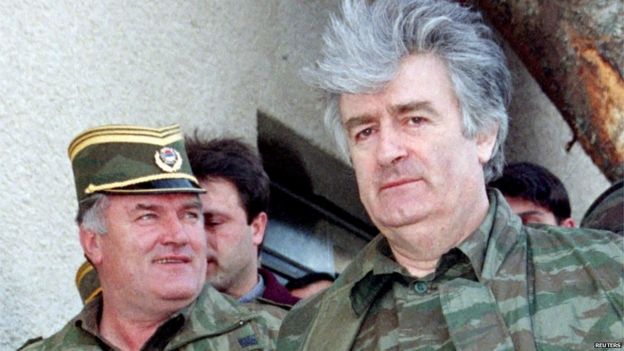
Former Bosnian Serb army chief Ratko Mladic and former Bosnian Serb leader Radovan Karadzic are both on trial at The Hague, accused of crimes relating to the massacre.
The ICTY and the International Court of Justice have called the events genocide.
The Srebrenica massacre came amid the bloody break-up of Yugoslavia into independent states in the 1990s.
Serbia backed Bosnian Serb forces fighting the Muslim-led Bosnian government during the conflict.
In July 1995, in what was supposed to have been a UN safe haven, Bosnian Serb forces took control of Srebrenica. They rounded up and killed about 8,000 men and boys and buried them in mass graves.